With This Cream, My Grandmother Looks 35 at 65: The Parsley Collagen Face Mask Everyone Is Talking About
There’s something timeless about the beauty routines passed down from our grandmothers. Long before expensive serums and complicated skincare routines became popular, many women relied on simple ingredients from the kitchen and garden.
One of those ingredients is fresh parsley.
You may have seen recipes online claiming that a parsley-based face mask can make mature skin look dramatically younger. While no homemade cream can actually turn back the clock or make a 65-year-old look 35 overnight, a simple parsley mask can be a refreshing addition to a skincare routine.
The real secret is not magic—it’s hydration, antioxidants, consistency, and protecting your skin from further damage.
Why Parsley Is Interesting for Your Skin
Parsley contains vitamin C and other antioxidant compounds. Vitamin C is particularly interesting in skincare because it helps protect skin from oxidative stress and plays a role in collagen production. Research on topical vitamin C has found potential benefits for photoaging, pigmentation, and collagen-related processes.
However, there is an important distinction: fresh parsley in a homemade mask isn’t equivalent to a professionally formulated vitamin C serum. The concentration, stability, and ability of ingredients to penetrate the skin are very different.
Still, parsley can be used as part of a gentle, hydrating DIY beauty ritual.
The Simple Parsley Face Mask
Ingredients
- 1 small handful of fresh parsley
- 1 tablespoon plain yogurt
- 1 teaspoon honey
- 1 teaspoon finely ground oats
How to Make It
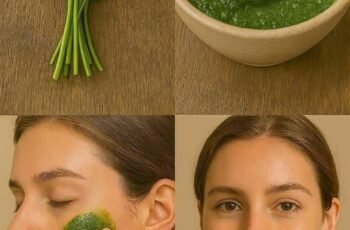
- Wash the parsley thoroughly.
- Finely chop or blend it until you have a soft paste.
- Add the yogurt, honey, and finely ground oats.
- Mix everything until you have a smooth, creamy consistency.
- Apply a thin layer to clean skin, avoiding the eye area.
- Leave it on for approximately 10–15 minutes.
- Rinse gently with lukewarm water.
- Finish with a simple moisturizer.
The result should be soft, hydrated, refreshed-looking skin—not an instant facelift.
Why These Ingredients Work Well Together
🌿 Parsley
Parsley provides plant compounds and vitamin C. Vitamin C has antioxidant properties and is involved in collagen synthesis, although the amount delivered by a homemade parsley mask is not well established.
🍯 Honey
Honey can help create a moisturizing feel and makes the mask more pleasant to apply. If you have sensitive skin, however, patch testing is a good idea.
🥣 Oats
Finely ground oats can make a gentle addition to a mask. Avoid aggressively scrubbing the skin when removing it.
🥛 Yogurt
Plain yogurt provides moisture and contains lactic acid, an alpha-hydroxy acid. But because homemade mixtures aren’t standardized, people with sensitive skin should be cautious.
What About “Collagen”?
This is where many viral skincare recipes become misleading.
A homemade parsley mask does not contain enough collagen to rebuild the collagen in your skin. In fact, dermatology experts note that topical collagen itself has difficulty penetrating the skin because collagen molecules are large.
Instead, the idea behind a “collagen mask” is usually to support the appearance of hydrated, smoother skin and, when appropriate ingredients are used, support processes associated with healthy skin.
Dermatologists also note that facial masks can temporarily improve hydration and the appearance of skin, while ingredients such as vitamin C and peptides may provide additional skincare benefits.
Can It Really Make You Look 35 at 65?
That’s a fun headline—but it shouldn’t be taken literally.
No homemade mask can reliably erase decades of wrinkles, restore lost facial volume, or make someone biologically younger. According to the American Academy of Dermatology, the effects of skin-firming creams are generally subtle, and moisturizers can temporarily make fine lines appear less noticeable by improving hydration.
What a good skincare routine can do is help your skin look:
- More hydrated
- Smoother
- Brighter
- More comfortable
- Healthier and more refreshed
And that’s already a worthwhile result.
The Most Important Anti-Aging Step
If your goal is younger-looking skin, don’t focus on one viral mask.
Daily sun protection is one of the most important things you can do to reduce photoaging. Vitamin C is also a well-studied antioxidant ingredient in skincare, although the formulation matters considerably.
A simple routine can be:
Morning:
Cleanser → antioxidant/vitamin C product → moisturizer → broad-spectrum sunscreen
Evening:
Cleanser → moisturizer → appropriate anti-aging treatment
A homemade parsley mask can simply be an occasional extra.
A Few Safety Tips
Before applying any DIY mask to your entire face:
- Test a small amount on a discreet area first.
- Don’t use it on broken or irritated skin.
- Avoid the eye area.
- Stop immediately if you experience burning, swelling, or significant irritation.
- Don’t scrub your face aggressively when removing the mask.
- Make a fresh batch rather than storing homemade mixtures for long periods.
If you have eczema, rosacea, severe acne, or very sensitive skin, it’s better to ask a dermatologist before experimenting with homemade facial treatments.
The Bottom Line
The beauty of this parsley mask isn’t that it can magically make a 65-year-old look 35.
Its appeal is much simpler: fresh ingredients, hydration, antioxidants, and a relaxing skincare ritual.
Parsley contains vitamin C, and vitamin C has genuine scientific interest in skincare and collagen-related processes. But the dramatic claims often attached to homemade “collagen masks” go far beyond the available evidence.
So if your grandmother has a glowing complexion at 65, perhaps the real secret isn’t one miracle cream at all.
It may be years of taking care of her skin, staying consistent, protecting herself from the sun—and knowing that beautiful skin doesn’t have to look 35 to look amazing.